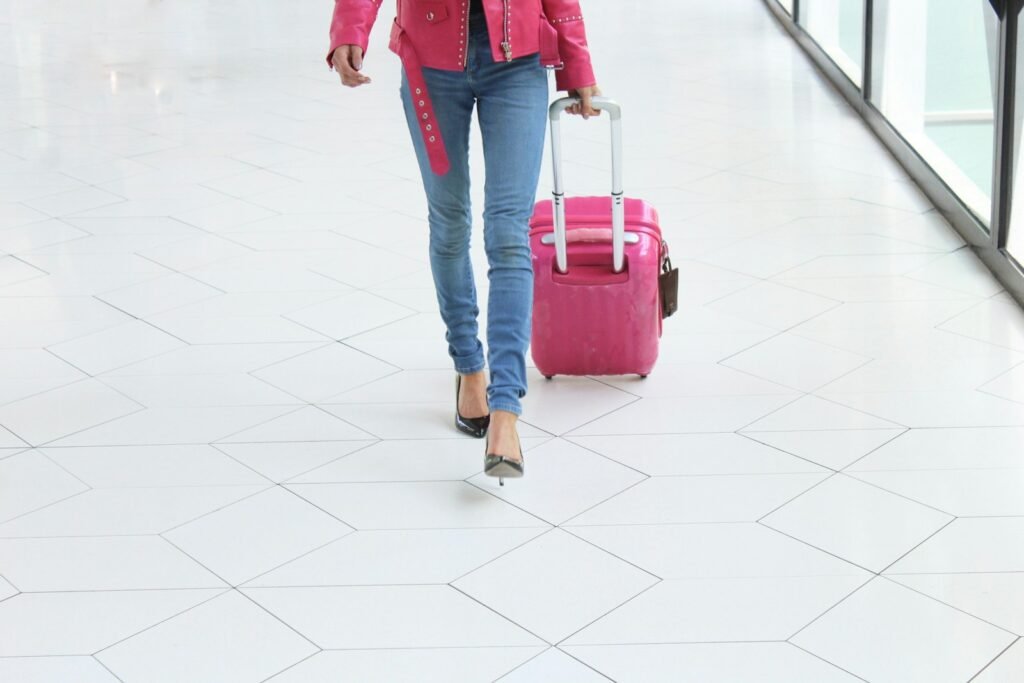
American Airlines allows one carry-on bag up to 22 x 14 x 9 inches (56 x 36 x 23 cm) and one personal item up to 18 x 14 x 8 inches (45 x 35 x 20 cm). The carry-on measurement includes wheels and handles, which is where most travelers get caught out. If your suitcase is 22 inches tall in the body and the handle adds another inch and a half, the bag is 23.5 inches as far as the gate agent is concerned.
That single rule explains almost every carry-on argument at the boarding door. The rest of this guide covers what counts, what does not, when weight matters, and how to tell before you leave home whether your bag will clear the sizer.
The two bags you can bring
Every American Airlines passenger, including Basic Economy, gets two pieces into the cabin at no extra cost. One goes in the overhead bin, one goes under the seat in front of you.
| Bag | Maximum size (inches) | Maximum size (cm) | Where it goes |
|---|---|---|---|
| Carry-on | 22 x 14 x 9 | 56 x 36 x 23 | Overhead bin |
| Personal item | 18 x 14 x 8 | 45 x 35 x 20 | Under the seat |
A personal item is a purse, a laptop bag, a small backpack, or a soft tote. Plenty of standard work backpacks are close to 18 inches tall once they are full, so if you are packing one as your under-seat bag, measure it loaded rather than empty.
Why wheels and handles count against you
Luggage makers measure differently from airlines. A suitcase sold as a 22-inch carry-on is often 22 inches in the packing compartment, with wheels and a retractable handle sitting outside that figure. Measure yours the way an airline does: stand it upright on the floor, push the handle all the way down, and run a tape measure from the floor to the highest point of the bag.
Depth is the other number that trips people up. The 9-inch limit refers to the bag at rest, not the bag with an expansion zipper opened and a jacket stuffed into the front pocket. Soft-sided bags give you some room to compress here. Hard shells do not, so a hard case that measures 9 inches empty is a hard case that measures 9 inches full, which is one reason they clear the sizer more reliably.
Is there a weight limit on American Airlines carry-ons?
American does not publish a carry-on weight limit for flights on its own mainline aircraft. The practical limit is whether you can lift the bag into the overhead bin without help, which cabin crew will expect you to do.
Two situations change that. Some airports outside the United States weigh cabin bags at the security or boarding check regardless of which airline you are flying. And if part of your itinerary is operated by a partner airline on a shared code, that carrier’s own cabin baggage rules apply to its leg, and many of them do set a weight limit. Check the operating carrier for each flight on your booking rather than the airline whose code is on the ticket, and confirm the current allowance on the operating airline’s own site before you fly.
Basic Economy still includes a full carry-on
American’s Basic Economy fares include the same carry-on and personal item as a standard main cabin ticket. What Basic Economy takes away is seat selection, upgrade eligibility, and flexibility to change the ticket, along with later boarding. Later boarding has a practical effect on your bag: by the time group 8 or 9 reaches the aircraft, overhead space near your row may be gone, and you may be asked to check your carry-on at the door.
Gate-checking at the boarding door is normally free when the crew runs out of bin space. The downside is that you lose access to the bag until you land, so anything you need during the flight, along with anything valuable or fragile, should move into your personal item before you hand the bag over.
Regional flights have smaller bins
Flights marketed as American Eagle run on regional jets flown by partner operators, and the smaller aircraft in that group have overhead bins that will not take a full-size 22-inch roller. On those flights, standard carry-ons are tagged at the gate, carried down to the hold, and returned to you on the jet bridge when you arrive.
This is worth planning for on connecting itineraries, where a wide-body transatlantic leg feeds into a small regional aircraft for the last hop. The aircraft type appears on your booking and boarding pass. If you see a regional jet on any leg, pack with the assumption that your roller bag will spend that flight in the hold.
What does not count toward your two bags
Several categories ride free and separately from your carry-on and personal item:
- A jacket or coat you are carrying
- Food or a drink bought after security
- A diaper bag, when you are traveling with a child
- A stroller and an approved child restraint seat
- Mobility aids and other assistive devices, including a wheelchair, walker, crutches, or a cane
- A breast pump and a small cooler for milk
- Duty-free items in the retailer’s sealed bag on some international routes
Medical equipment and medication also travel outside the two-bag count. Carrying a doctor’s note is not required, but keeping prescriptions in labeled original packaging makes conversations at security shorter.
Getting through the gate without a problem
Measure the bag at home with the handle retracted and write the three numbers somewhere you will find them, because you will buy luggage again. If your bag sits within a quarter inch of a limit, treat it as oversized and plan accordingly, since sizers vary and so do agents.
Pack the heavy, dense items low and toward the wheels. A bag that holds its shape goes into a sizer cleanly, while one that bulges at the top catches on the frame. Leave the expansion zipper closed, and move anything that pushes the depth past 9 inches into your under-seat bag instead.
If your bag is too large, checking it at the ticket counter costs less than paying at the gate in most cases, and it saves you from carrying it through the terminal. Bag charges, exemptions, and elite allowances change, so confirm the current amounts on aa.com for your specific route and fare before you travel. Our guide to packing light for travel covers how to get a week of clothes into a bag this size, and the international packing list is a useful starting point if you are heading overseas.
Liquids in your carry-on
Carry-on size is one limit; liquids are a separate one set by the TSA rather than the airline. Containers go up to 3.4 ounces (100 ml) each, and they all have to fit in a single quart-sized clear bag. A suitcase that passes the sizer can still be pulled apart at security over a full-size shampoo bottle. We cover the detail in how many ounces you can take on a plane.
Frequently asked questions
Does American Airlines measure carry-on bags at the gate?
Sometimes. Metal sizers sit at check-in and at many boarding doors, and agents use them when a flight is full or a bag looks oversized. Enforcement is inconsistent across airports, which is a poor reason to rely on getting waved through.
Can I bring a backpack and a carry-on suitcase?
Yes, as long as the backpack fits the 18 x 14 x 8 inch personal item limit and goes under the seat in front of you. A large hiking or camera backpack will usually count as your carry-on instead, leaving you one smaller bag.
Is a 24-inch suitcase allowed as a carry-on?
No. At 24 inches it is two inches over the limit before you add wheels, and it will not fit the sizer. Plan to check it.
What happens if my carry-on is slightly over the limit?
You may get through, or you may be sent back to check the bag and pay a fee at the gate. A bag an inch over often passes when the cabin is quiet and fails when the flight is full and the crew is watching bin space.
One more thing worth building into your trip budget: if you fly often enough that gate-checking is a recurring cost, the math on a smaller bag usually works out in a season or two. Our travel hacks guide has more ways to keep airport costs down.