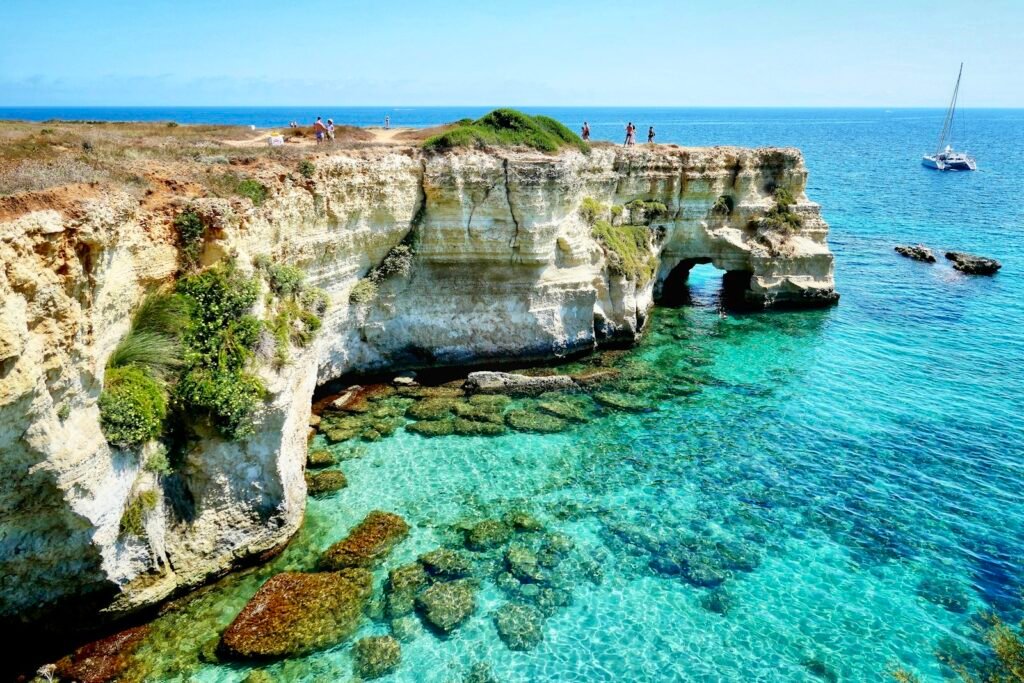
Puglia is the heel of Italy, and the single most important decision you will make is not which hotel but which town. The region is long — about 400km from the Gargano peninsula down to Santa Maria di Leuca — and the towns everyone photographs are spread across most of it. Base yourself badly and you will spend the week driving.
The good news is that Puglia rewards a single base better than almost anywhere in Italy, provided you pick the right one. Here is what each town is actually like to sleep in, and which one suits the trip you are planning.
The short answer
For a first trip of a week or less, base yourself in Monopoli. It sits on the coast roughly in the middle of the good stuff, it has a genuine working old town rather than a preserved one, and Alberobello, Polignano a Mare and Ostuni are all inside 40 minutes. If your trip is longer than a week, split it: north base plus Lecce.
- Best all-round base — Monopoli
- Best for the sea — Polignano a Mare
- Best for countryside and masserie — Ostuni or the Valle d’Itria
- Best for architecture and city life — Lecce
- Best for one memorable night — Alberobello
Monopoli
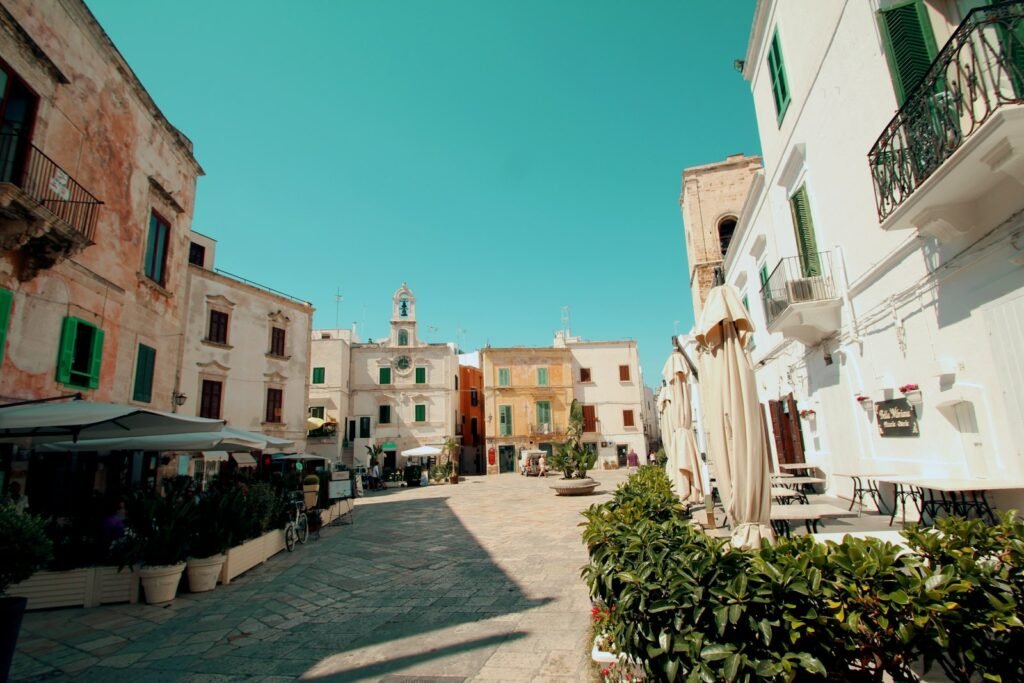
Monopoli is the pick for most people and it is not close. The old town is walled, whitewashed and still lived in, the harbour has actual fishing boats rather than decorative ones, and the restaurants are priced for locals because locals eat in them.
Its real advantage is geography. Alberobello is about 25 minutes inland, Polignano a Mare ten minutes up the coast, Ostuni around 40 minutes south. You can day-trip to all of them and be back for dinner without the day becoming a drive.
It is also on the Bari–Lecce railway line, which matters if you would rather not hire a car for the whole trip.
Stay here if: you want one hotel for the week and no regrets.
Polignano a Mare
The town on every Puglia photograph — white houses on a limestone cliff above impossibly clear water, with Lama Monachile beach wedged into a ravine below. It deserves the attention. It is genuinely striking.
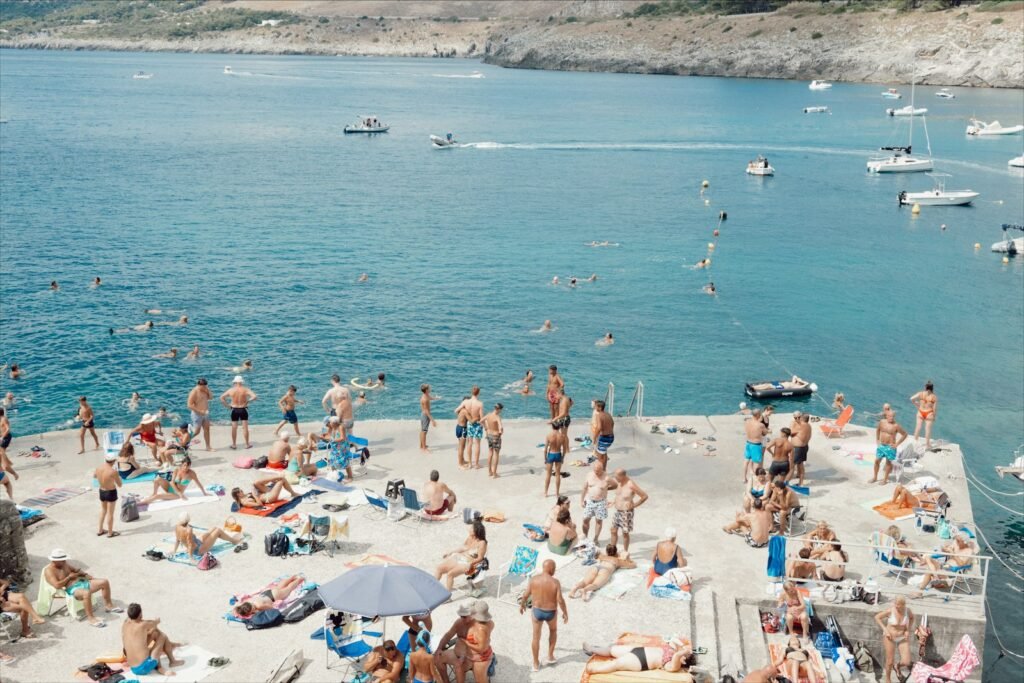
It is also small, and in July and August it is overwhelmed. The beach is tiny and fills by mid-morning; the clifftop viewpoints have queues. Staying here means you get the town in the early morning and after the day-trippers leave, which is the argument for it. The counter-argument is that you are paying a premium for a base with fewer restaurants than Monopoli fifteen minutes away.
Stay here if: the sea is the point of the trip, and you are travelling outside July and August.
Ostuni and the Valle d’Itria
Ostuni is the white hilltop town, visible for miles across the olive groves. The historic centre is a knot of lanes and staircases, and the restaurant scene is the best in the region outside Lecce.
The wider point is the Valle d’Itria around it — Locorotondo, Cisternino, Martina Franca — and the masserie, fortified farmhouses converted into hotels. This is where Puglia’s luxury accommodation actually is. If you pictured a pool surrounded by olive trees, that picture is a masseria in the Valle d’Itria.
Note the trade-off: the old town is steep, and masserie are rural, so a car is not optional here.
Lecce
Lecce is the one genuine city on this list, and it is extraordinary — a baroque centre carved from soft golden limestone, with a Roman amphitheatre in the main square. It has bookshops, bars, students and a life that continues after the tourists go home.
The catch is distance. Lecce sits deep in the Salento, well over an hour from Alberobello and Polignano. It is a poor base for the northern sights and an excellent base for the southern beaches and Otranto. Treat it as a second base, not a substitute.
Stay here if: you are staying two weeks, or you care more about architecture and food than beaches.
Alberobello
The trulli town — hundreds of conical drystone roofs packed into two districts, and a UNESCO site. It is remarkable and it is also, by day, the most touristed square kilometre in Puglia.
Sleeping in a converted trullo is a genuinely good experience and the town empties dramatically in the evening. But it is inland, small, and has little to do after one full day. One or two nights, not a week.
Where not to base yourself
Bari is the arrival airport and the transport hub, and people book it out of convenience. The old town has improved enormously and is worth a day, but as a base you are in a working port city with the sights an hour away in each direction.
Similarly, avoid booking a masseria as your only accommodation if you do not intend to drive. They are frequently 15 to 20 minutes down an unlit country road from the nearest restaurant.
When to go, and what it costs
July and August bring the highest prices, the fullest beaches and temperatures that make midday sightseeing unpleasant. May, June, September and early October are the sweet spot — warm sea, manageable crowds, and rates noticeably below peak.
Puglia remains better value than Tuscany or the Amalfi Coast, though the gap has narrowed. Expect agriturismi and B&Bs from around €70–110 outside peak, mid-range town hotels €110–180, and masserie from roughly €200 upward, rising steeply in August. Treat these as indicative and check your exact dates.
Do you need a car?
Mostly yes. The train line along the Adriatic coast connects Bari, Monopoli, Ostuni and Lecce reasonably well, so a coastal-town trip is possible without one. But the Valle d’Itria, the masserie and the smaller beaches are effectively unreachable by public transport.
If you are hiring, note that most historic centres are ZTL — restricted traffic zones, camera-enforced, with fines arriving months later. Confirm parking with your hotel before you arrive, not after.
Frequently asked questions
How many days do you need in Puglia?
Five to seven for the classic loop of Monopoli, Polignano, Alberobello, Ostuni and the Valle d’Itria. Ten or more if you want to add Lecce and the Salento properly.
Is one base enough?
For a week, yes, if that base is Monopoli or Ostuni. For longer, split between a northern base and Lecce to avoid repeating long drives.
Which airport?
Bari for the north and the Valle d’Itria. Brindisi is closer to Ostuni, Lecce and the Salento, and is frequently the better choice.
Is the sea good for swimming?
Yes, though much of the coast is rock rather than sand. Polignano and Monopoli have small coves; the long sandy beaches are mostly in the Salento, south of Lecce.
More of the country: the best places to visit in Italy, where to stay in Milan, and the Amalfi Coast guide if you are combining regions.