Naxos is the largest of the Cyclades and the one that still functions as a real island rather than a stage set. It grows its own food, it has mountain villages with no tourism at all, and it has the best beaches in the island group. It is also considerably cheaper than Santorini or Mykonos, which is most of why people end up here.
The choice of base comes down to one question: town or beach. Naxos is big enough that this genuinely matters, and unlike smaller Cycladic islands you cannot easily do both from one place without transport.
The short answer
Without a car, stay in Chora (Naxos Town). It has the ferry port, the bus station, the restaurants and the nightlife, and you can still reach the good beaches by bus. With a car, or if the beach is the entire point, stay at Agios Prokopios or Agia Anna.
- No car, short stay, late ferry — Chora
- Best beach base overall — Agios Prokopios
- Same beaches, lower prices — Agia Anna
- Space and quiet — Plaka
- Families with young children — Agios Georgios
Chora (Naxos Town)
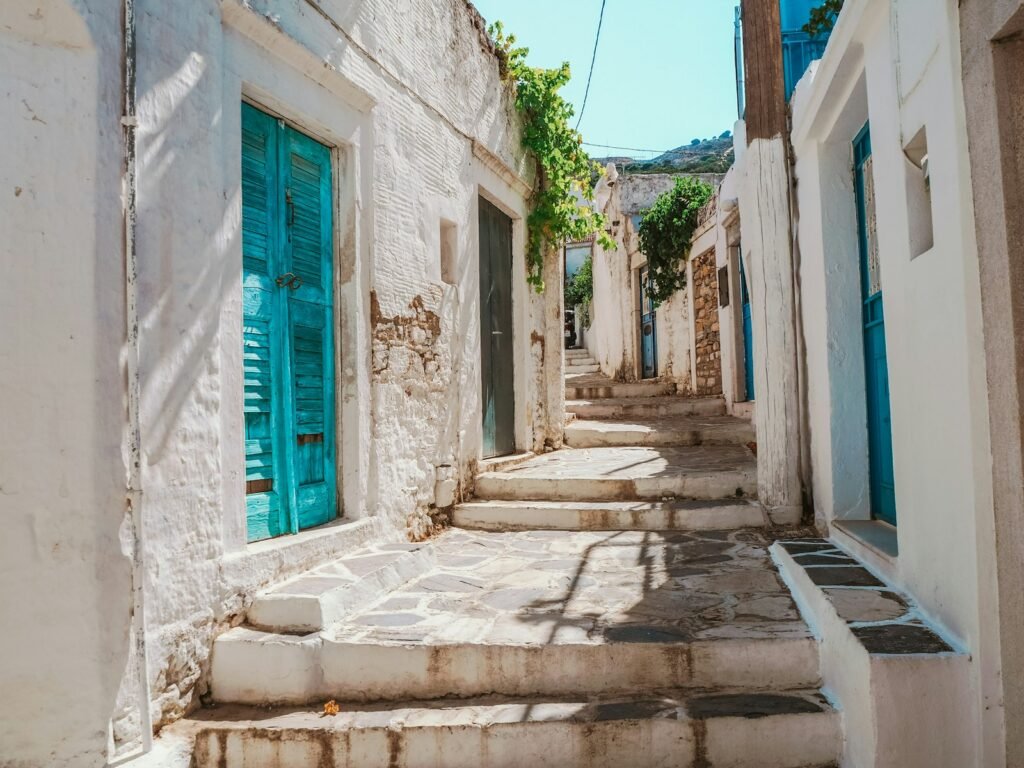
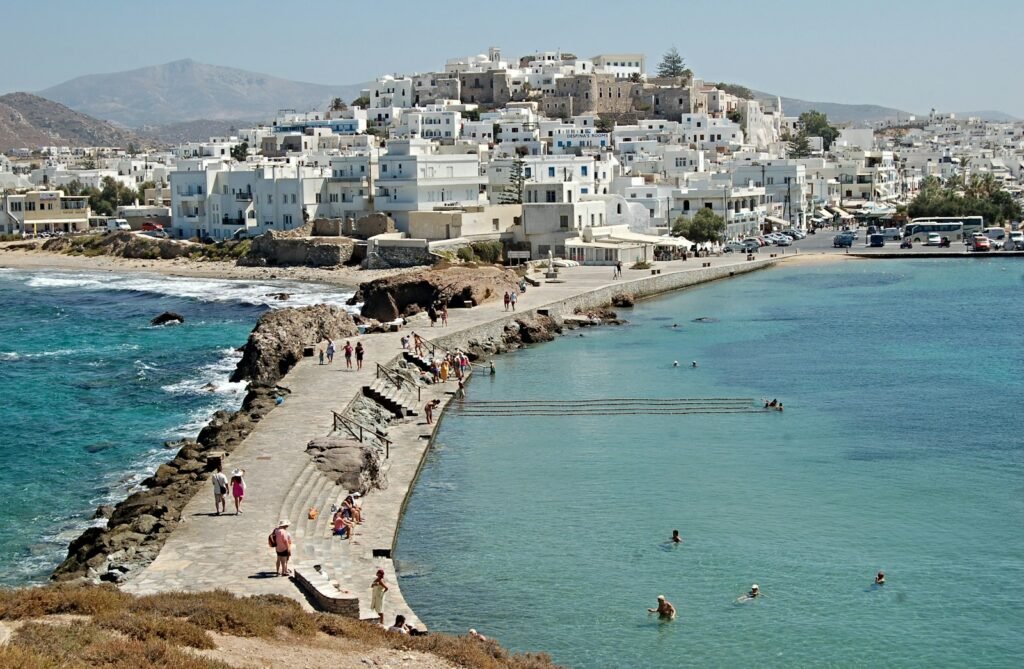
The main town, built around a Venetian kastro with a maze of whitewashed lanes below it, and the Portara — a freestanding marble doorway from an unfinished temple of Apollo — on the islet at the harbour mouth. Sunset there is the island’s ritual.
Practically, Chora is the sensible default. The ferry docks here, the buses leave from here, and it has by far the widest choice of restaurants and shops. If you are arriving late, leaving early, or staying only two or three nights, stay here and do not overthink it.
Its weakness is the beach. Agios Georgios at the town’s edge is shallow, sheltered and fine for children, but it is not why anyone comes to Naxos.
Agios Prokopios
About 10 minutes south of town, and the best all-round beach base. A long stretch of pale sand and unusually clear water, with organised sections, sunbeds, tavernas and a good spread of small hotels and studios.
It is busy in July and August — this is the island’s most popular beach — but the bus service to Chora is frequent enough that you are not stranded, and you can walk along the sand to Agia Anna in about fifteen minutes.
Stay here if: you want beach days as the default and town as the outing.
Agia Anna
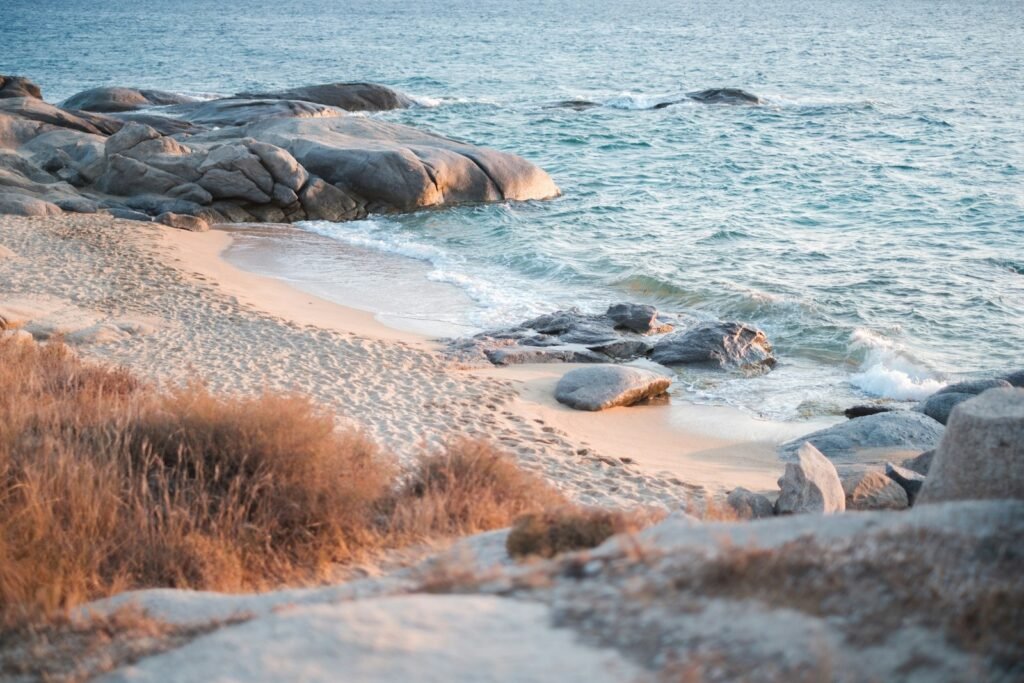
Immediately south of Agios Prokopios and effectively continuous with it, but smaller, quieter and cheaper. It began as a fishing village and still has a small port at its southern end.
This is the value pick on the beach strip: the same water, the same sand, noticeably lower rates, and a shorter list of restaurants. For most trips it is the better call than its busier neighbour.
Plaka
South again, and the best beach on Naxos — four kilometres of uninterrupted golden sand backed by low dunes and cedar. It is far less developed than the beaches north of it, which is the entire appeal.
The trade-off is obvious: fewer tavernas, fewer shops, and a real need for a car or scooter. There is a naturist stretch at the southern end, which is well signposted and easily avoided if that is not your thing.
Stay here if: you have transport and you want the beach to be the holiday.
The mountain villages
Worth knowing about even if you do not sleep there. Halki, Apiranthos and Filoti sit inland in the Tragaea valley, among olive groves and Venetian towers, and they are what separates Naxos from the drier Cyclades. Apiranthos is built almost entirely of marble.
A few small guesthouses exist, and they suit a night or two at the end of a beach trip. They do not suit a first visit or a short one.
What it costs
Naxos is meaningfully cheaper than the famous Cyclades. Expect simple rooms and studios from around €50–80 outside peak, mid-range hotels roughly €90–160, and the better boutique properties from €180 upward.
High season is the sharp edge: average rates roughly double between the shoulder months and August, and the best-value studios in Agia Anna and Agios Prokopios sell out months ahead. June and September give you swimmable sea, open tavernas and considerably lower prices.
Getting there and around
Ferries run from Piraeus in Athens — roughly three and a half hours on a fast boat, five to six on a conventional ferry, and the slower ones are considerably cheaper and less prone to cancellation in wind. Naxos also connects easily to Paros, Mykonos, Ios and Santorini, which makes island-hopping straightforward.
There is a small airport with domestic flights from Athens.
On the island, buses link Chora to the western beaches frequently in summer and sparsely otherwise. For Plaka, the mountain villages or the quieter southern beaches, hire a car. Note that the meltemi wind blows hard through July and August on the exposed western coast — it is why the sheltered southern beaches fill up on windy days.
Frequently asked questions
How many days do you need in Naxos?
Four to five. Two for beaches, one for the mountain villages, one for Chora and the kastro, one spare for weather.
Is Naxos better than Paros?
Naxos has better beaches, better food and a stronger interior. Paros has better nightlife and more polished hotels. They are 45 minutes apart by ferry, so many trips include both.
Do I need a car?
Not if you stay in Chora or on the western beach strip. Yes if you want Plaka, the south, or the villages.
Is Naxos good for families?
Very. Agios Georgios and Agia Anna both have shallow, calm water, and the island is relaxed and inexpensive by Greek island standards.
More of the country: the Greek Islands guide and the Santorini couples guide if you are combining islands.