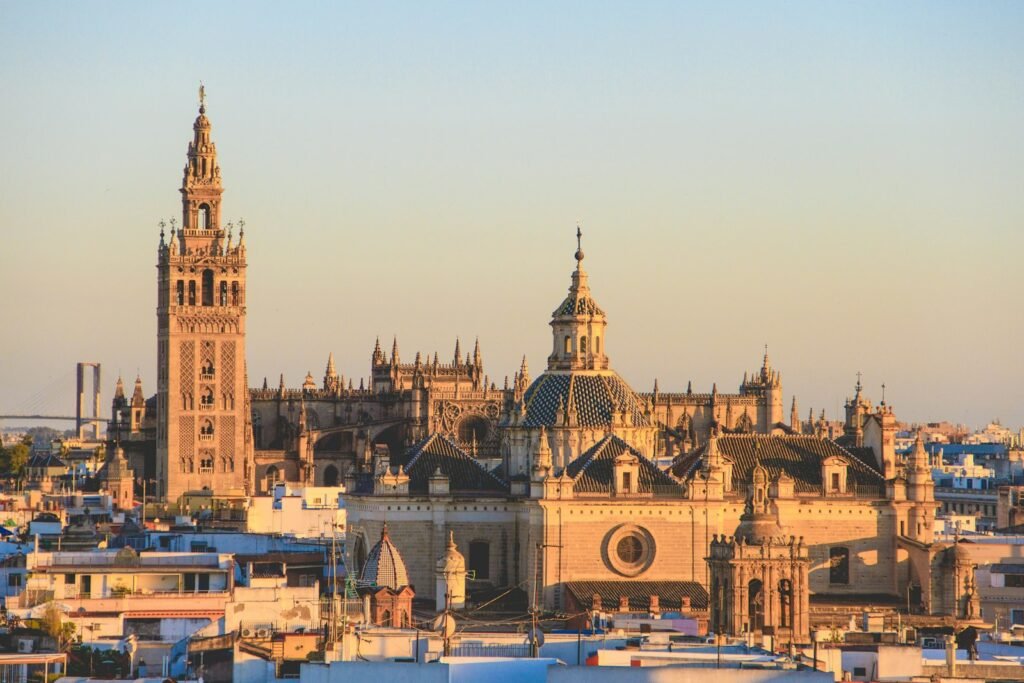
If you are booking a first trip to Seville, stay in or on the edge of Santa Cruz, the old quarter beside the cathedral. If you have been before, or you care more about where you eat dinner than how close you sleep to the monuments, cross the river to Triana. Everything below explains why, what each area costs, and the two weeks of the year when the whole city sells out.
Seville is small for a city with its reputation. You can walk from the cathedral to Triana in about twenty minutes, and nearly everything a first-time visitor wants sits inside a compact historic core. That makes your choice of neighborhood less about getting around and more about what you want your evenings to feel like.
One thing matters more here than in most Spanish cities: heat. Summer afternoons in Seville regularly pass 100°F, and in July and August they go well beyond it. The difference between a hotel with a shaded courtyard and one without is not a minor comfort question, and neither is working air conditioning. Check both before you book a summer stay.
The short answer
- First visit, everything on foot: Santa Cruz.
- Atmosphere without the crush of day visitors: Alfalfa and Santa Catalina.
- Local life, food markets and flamenco: Triana.
- Quiet and central, easy with luggage: El Arenal.
- Better value, short walk or tram ride in: La Macarena or Nervión.
Santa Cruz
The old Jewish quarter, and the version of Seville on the postcards: whitewashed lanes barely wide enough for two people to pass, orange trees, tiled patios, and the cathedral at the end of it. The Real Alcázar and the Giralda bell tower are both on the doorstep.
Those lanes are also the drawback. They are narrow, they fill with day visitors from mid-morning, and hauling a wheeled suitcase over the cobbles to a hotel no taxi can reach is a Seville rite of passage you can avoid with one email. Ask your hotel exactly where a car is able to drop you, and how far you walk from there.
You pay a premium for the address and rooms tend to be small, often in converted houses where no two rooms are the same size. What you get in return is the ability to be at the Alcázar gate when it opens, before the queues and before the heat, which is the single best hour you will spend in the city.
Alfalfa and Santa Catalina
Immediately north of Santa Cruz, and for most travelers the better base. You are five to ten minutes from the cathedral, the streets are wide enough to walk two abreast, the tapas bars hold more locals than tourists, and rates sit a step below the historic core.
This is the part of the center to stay in if your evenings revolve around eating. The density of good, unfussy tapas bars around Plaza de la Alfalfa is the highest in the city, and standing at the counter with a plate and a glass is the normal way to do it rather than the budget way. Las Setas, the large wooden structure in Plaza de la Encarnación, is a few minutes north and has a rooftop walkway worth timing for sunset.
Triana
Across the Guadalquivir, and historically a separate town with an identity it still defends: ceramics workshops, a sailors’ past, and a claim to being the birthplace of flamenco that Triana will argue at length.
The Puente de Isabel II puts you ten minutes from the cathedral on foot, so “across the river” is far less remote than it sounds. Calle Betis runs along the water with the views back to the old city, and the Mercado de Triana is a working food market rather than a souvenir one. Several of the ceramic shops on and around Calle Antillano Campos still paint tiles on site.
Stay here if you would rather eat well than sleep closest to the monuments. It also tends to run a little cheaper than the center for the same standard of room.
El Arenal
Between Santa Cruz and the river, around the Maestranza bullring and the Torre del Oro. Quieter in the evenings than Santa Cruz, flat, reachable by taxi to the door, and still about five minutes from the cathedral. If you are traveling with heavy luggage, with children, or with anyone who would rather not negotiate cobbled lanes, this is the sensible choice in the center.
La Macarena, Los Remedios and Nervión
La Macarena, north of the center, is where the value is. It is a real neighborhood with a basilica worth seeing and a walk of roughly 15 to 25 minutes into the middle, depending on how far up you book.
Los Remedios sits across the river south of Triana. It is residential and unremarkable most of the year, and it is also where the Feria de Abril fairground is built, which makes it either the perfect base or the worst one depending on your dates.
Nervión, east of the center, is modern and business-oriented. It is cheaper again and well connected by the metro line, but nobody stays there for the atmosphere. All three make sense if the center is beyond your budget, and none of them is somewhere you would choose on charm alone.
When to go, and the two weeks to book around
Timing matters more in Seville than almost anywhere else in Europe. Spring and fall are excellent. July and August are punishing, and locals who can leave in August do, which means a share of restaurants close for the month.
Two events fill the city completely. Semana Santa, the week before Easter, brings processions through the center day and night. The Feria de Abril follows roughly two weeks after Easter Sunday, which means both move with the date of Easter and can land in March, April or early May. During either one, room rates double or triple and hotels sell out months in advance. Both are worth seeing on purpose. Neither is something to walk into by accident, so check the dates against your trip before you book anything.
What it costs
Seville is still good value by Western European standards, though rates move with the season and the calendar above, so treat these as ranges rather than quotes. Hostel beds tend to start around €25 to €40. Mid-range hotels in the center run roughly €80 to €150. Boutique rooms in restored palace houses start somewhere near €180 and climb from there. Expect all of these to spike during Semana Santa and the Feria, and to soften noticeably in the August heat, which is the one time of year the city is cheap.
Getting around
Walk. The historic center is largely pedestrianized and small enough that waiting for transport usually costs you more time than walking does. There is one metro line and one tram line, and neither is much use if you are staying centrally.
From the airport, the EA bus runs into the center in about 35 minutes and is the cheapest way in. Santa Justa station handles the high-speed AVE trains, which put Madrid around two and a half hours away and Córdoba under an hour, close enough for an easy day trip. Cádiz is roughly an hour and three quarters on a regional train. Check current timetables and fares with Renfe before you plan a day around one.
Two things to check before you book
- Where a taxi can stop, and how far you then walk with your bags. This is the most common complaint about Santa Cruz hotels and the easiest to avoid.
- Whether the room has real air conditioning rather than a single wall unit shared with the corridor, if you are traveling between June and September.
Frequently asked questions
How many days do you need in Seville?
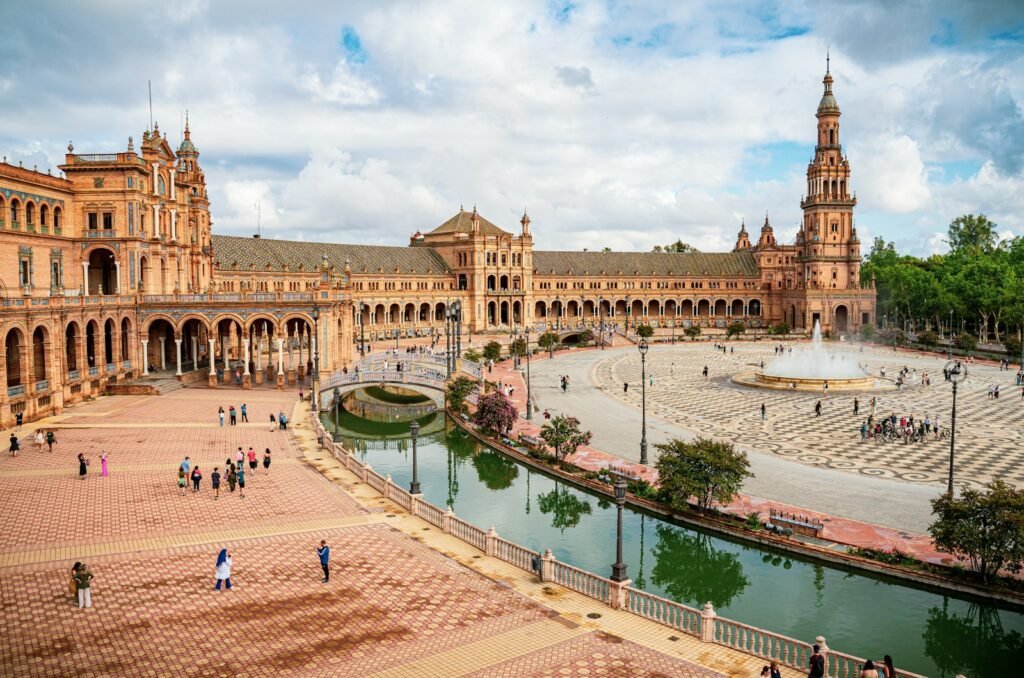
Three is comfortable: one for the Alcázar and the cathedral, one for Triana and the Plaza de España, and one left loose. Two works if you have already booked the Alcázar for an early slot.
Do you need to book the Alcázar in advance?
Yes. Entry is by timed ticket and slots sell out days ahead in season. The same goes for the cathedral roof tours. Book through the official sites rather than a reseller, and check current opening hours there, since they change between summer and winter.
Is Santa Cruz manageable with luggage?
The center as a whole is walkable, but the cobbled lanes of Santa Cruz with a wheeled case are hard work. If that is a concern, book El Arenal or Alfalfa instead and you lose almost nothing in walking distance.
Where should you see flamenco?
Small venues in Triana and around Alfalfa rather than the large dinner shows aimed at tour groups. Casa de la Memoria and Casa de la Guitarra are the names that come up most often for intimate performances. Venues here open and close, so check current schedules and book a day or two ahead in season.
More of the country: the best places to visit in Spain, where to stay in Barcelona, and when to visit Rome if you are pairing Seville with another European city.